

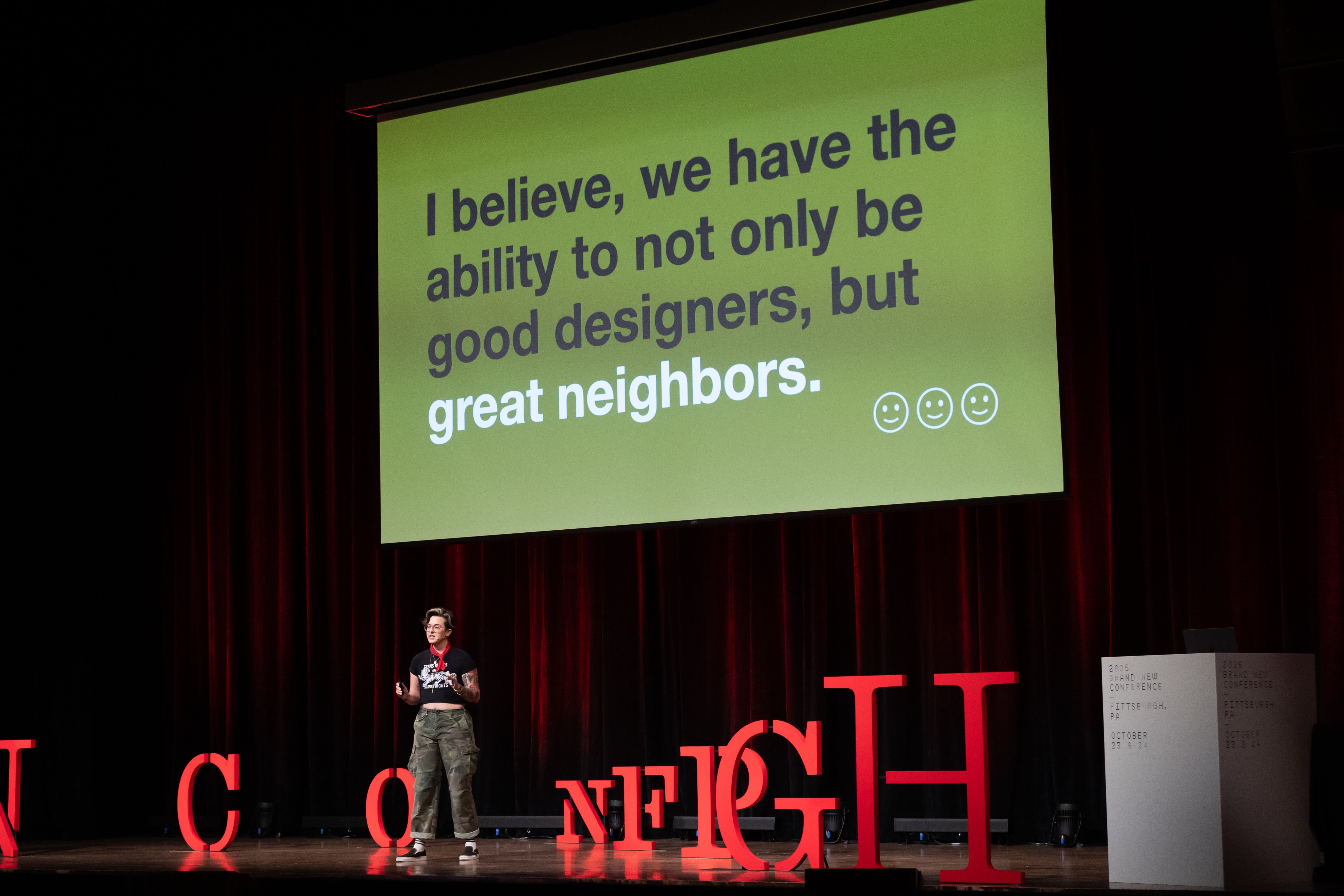
The Brand New Conference is a two-day event on corporate and brand identity with some of today’s most active and influential practitioners from around the world. In October of 2025, Brand New came to my city of Pittsburgh, PA and I had the pleasure of sharing with 800+ attendees my thoughts on community, being a good neighbor, and the role of the designer beyond our computers. The talk begs the question, how can designers embody the ethos and practice of a good neighbor?
Transcript —
Read Time: 13mins
Thank you so much for being here. I'm so proud to be representing Pittsburgh today. Let's get started. I've got some notes. I've got my script in a little bit of time, so let's get going. Ooh, okay. So good afternoon, everyone.
I'm Sidney Rose. I use they-them pronouns, and I am the owner and creative director of Houndstooth USA. I hold many titles and identities like brand designer and illustrator, and I am also a trans and disabled activist and community organizer right here in Pittsburgh.
I worked for years in the agency world, but I was quickly disillusioned by the lack of values and accountability that I saw around me. We bid on projects for their notoriety, creative value, and the size of their budgets.
We shared meetings with CEOs, marketing strategists, and board members. But the people we were supposedly designing for, they were nowhere to be found. Since venturing off to become an independent designer nearly 10 years ago, I have been searching for the meaning that I was looking for all that time.
I now believe that designers have a pivotal and untapped role within our communities, helping real people, which is what I would like to talk to you about today. We're talking about design, of course, that's why we're all here, but we're also talking about what comes after.
So this word community, we throw it around a lot. In client meetings, in mission statements, in brand narratives... Does anyone actually know what this word means?
Studies show that the United States is ranked number one in hyper-individualism. Social isolation is on the rise. While the loneliness epidemic has been recognized as a public health issue by the U.S. Surgeon General and the World Health Organization, we've simply lost the skills needed to both build and be a part of a true community.
So why has community become such a buzzword when we've become anything but?
Is this ubiquitous branding term an attractive window dressing for an otherwise capitalistic endeavor? Or is it a collective prayer for an interdependent future?
In a community, the fundamental civic unit is what? Homeowner, business owner, resident?
I like to believe. It's neighbor.
But due to the rise of hyper-individualism and social isolation, being a good neighbor is a lost art.
One of my favorite neighbors taught me that being a good neighbor means being kind and considerate and accountable for each other. Perhaps some of you know him.
Host of Mr. Rogers Neighborhood and Pittsburgh Local, Fred Rogers taught generations of us to practice loving reciprocity, to see value in building relationships for the long term, and truly co-creating community and a sense of real belonging. He taught us that we are all responsible for the well-being of our communities.
He's quoted saying, "we live in a world in which we need to share responsibility. It's easy to say, not my child, not my community, not my problem. Then there are those who see the need and respond, and I consider those people my heroes."
Civil rights activist and writer James Baldwin wrote, "the children are always ours, every single one of them, all over the globe. And I am beginning to suspect that whoever is incapable of recognizing this may be incapable of morality."
Now I think that these two would have made for very good neighbors.
Now let's take a look at the current landscape of many communities across the United States...
Luxury apartments, national chains, high-end art galleries, trendy names for a rebranded neighborhood like Lodo and Soto and Weho, while one more Froyo spot opens up next to yet another bougie bar peddling $18 cocktails.
Tell me, is this community?
Is this what we really want over connection?
Is this the world that we want to build together?
In 2015, in the East Liberty neighborhood of Pittsburgh, developers displaced over 200 low-income residents in the Penn Plaza apartment complex. The land was razed for a new urban development, including a larger location for the pre-existing Whole Foods and Amazon, corporate offices, and luxury apartments. The neighborhood of East Liberty had been a prominent black neighborhood for nearly 65 years, and this was largely due to a previous displacement of the Hill District, colloquially known as Little Harlem, of nearly 8,000 mostly black residents and 400 businesses back in the 1950s.
Whole Foods pulled out of the development plans temporarily after protests and boycotts began, only to reemerge later, redevelop the land, and retain nothing but a gated and empty lot across the street where homes for low-income residents once lived.
On Whole Foods' website, they tout nourishing the people and planet as their core value. They go on to say their Whole Foods community giving programs, quote, provide a wide range of resources to help address existing and emerging needs in the communities we serve.
But if you were to set foot in that Whole Foods today, the demographic inside looks nothing like the demographic outside. Today, gentrification has shadowed every corner of East Liberty.
So, whose community are they actually serving?
The people making these choices weren't the people most impacted. So, why are people outside of our communities the ones making the decisions inside? These are the folks most impacted. And these are our neighbors.
Whole Foods claims to, "-address the existing and emerging needs in the communities we serve." Do you think that these two would agree?
Now, let me say this very clearly. This is not to burden designers with the mashed gentrification we are seeing nationally. But aren't many of these businesses that I've just highlighted brands that we at one point or another wanted to have on our client roster? Does our work emboldening their mission not give credence to their ethics?
We design their branding, their signs, their websites, their content. Don't our creative efforts manifest their intentions? I have never met a designer that didn't want to put goodness into their community.
And I believe that with the right intentions and business practices, we have the ability and responsibility to not only be good designers, but great neighbors. So how can designers embody the ethos and practice of a good neighbor?
While we obviously aren't the sole decision makers of our clients' futures, we still hold incredible influence. We decide which businesses we partner with and whose values we platform with our efforts and expertise.
Through market research, we study our clients' target demographics and advise them on how to communicate to and interact with their people through strategic design, copywriting, photography, and so many other areas.
We're all familiar with these visuals, but what if we are more familiar with these visuals? These are real people who made real change in their communities. They used their real voices to make the change together.
If we take a moment to look around at the demographics in this room, full of designers, or think of our studios back home, do we see the demographics of our actual communities represented? I don't. So why would I use only my perspective as the North Star for my clients? That would be a disservice.
What if the people we were serving, especially those who are most negatively impacted in our communities, actually had a voice in the process? What if in our pitch meetings, it wasn't just board members and CEOs and marketing strategists, but the voices of queer and trans neighbors, of black, indigenous, and neighbors of color, disabled neighbors, immigrant neighbors, low-income neighbors.
A great brand can be an invitation to the community, but that doesn't mean that it offers true belonging for everyone. Because access does not equal belonging. We must build with real people, for real people, not just for numbers, not just for dollars.
This is how we transcend beyond transaction and into relationship. And in a country that is plagued by loneliness and isolation, we are starving for a relationship. We're starving for neighbors. We must change our focus from how can I be profitable to how can I support my community.
What would it look like to see brand values like this?
- We prioritize investment and co-creation over extraction.
- We choose kinship over competition.
- We lead our clients and community with care, generosity, and reciprocity.
- We believe in leaving our community better than we found it.
There are many ways that we can begin this process, and I've listed some examples here. Ultimately, your business and your path is yours to co-create with your neighbors.
In April of this year, a team of neighbors, including myself, organized and hosted a really, really free market in the same East Liberty neighborhood, approximately one mile from the Whole Foods. I utilized my various resources, design, illustration, social media, marketing, et cetera, to promote the event.
We hosted approximately 200 to 300 people our first market and 400 to 500 the next, and we anticipate even more next spring. Neighbors came together to give that which they no longer needed and receive items that they did.
Some offered free haircuts, hot food, books, clothes, furniture, self-defense training, cancer screenings, bike repair, and so much more.
It was living proof of the true abundance of community. We are already in relationship with those around us just by being here.
But in a time when our communities, our neighbors, are being ripped apart by ice, by violent transphobic laws, by the repression of truth and the oppression of bodily autonomy and personal agency and systemic neglect.
We must be more than bystanders. We must be good neighbors.
So when you begin your next project, I have a few things that I hope you ask yourself:
Who is in the room with you? And who isn't?
At what cost and at whose expense?
And in keeping with being a good neighbor, may I proudly say with my full chest and my whole heart, trans rights are human rights. Black Lives Matter. Fuck ICE and free Palestine.

Liked this post? Give it a share: